
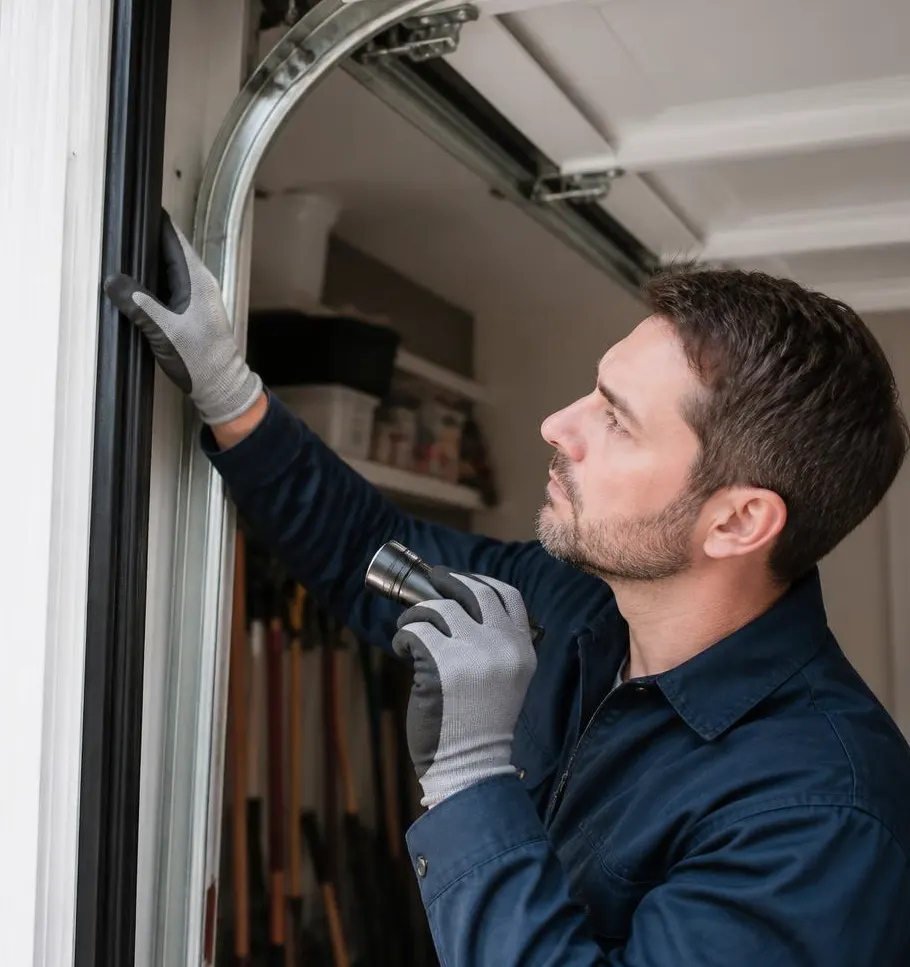
The Gap You Almost Didn't Notice
You're pulling the trash bins back into the garage and you spot it: a small tear near the top corner of the door, right where the panel meets the track. It looks like nothing — a scuff, maybe from moving a ladder. But run your finger along it and you'll find a slit just wide enough for a wire coat hanger. That's not wear and tear. That's a tool mark from someone trying to fish for your emergency release cord from outside.
Most homeowners picture a break-in as a crowbar and broken glass. The reality is quieter. Garage doors get beaten more often by small, repeatable tricks than by brute force, and most of those tricks exploit the same handful of weak points.
How It Actually Happens
Fishing the Emergency Release
Every garage door opener has a manual release cord so you can open the door by hand during a power outage. On many doors, there's enough of a gap at the top corner for someone to slide a thin wire or a bent coat hanger through, hook the cord, and pull. The door disengages from the opener and lifts right up. No alarm, no broken parts, no sign of forced entry until you're standing in an empty garage.
Prying the Bottom Seal
Older doors, or ones with a worn weather seal, can flex enough at the bottom corner for a pry bar to get a purchase. A few seconds of leverage and the door pops out of its track or bends enough to slide under. Salt air along the coast speeds up corrosion on tracks and rollers, which makes this easier on doors that haven't had maintenance in a while.
Smashing or Popping Out Windows
Decorative windows look great on a door, but on older models the panes are sometimes held in with a simple retainer that pops out with a sharp hit. Once there's an opening, reaching the emergency release or an interior lock takes seconds.
Grabbing Old Remote Codes
Openers made before the mid-2000s often used a fixed code that never changed. A cheap code-grabbing device parked nearby can capture that signal and replay it later. If your opener still has a dial switch with a row of tiny numbered pins instead of a sync button, this is a real risk, not a theoretical one.
Using the Garage as the Easy Way Into the House
Even when the garage itself has little of value, it's frequently the softest point of entry to the rest of the home. The interior door between garage and house is sometimes just a standard door with a cheap knob lock, installed with the assumption that the garage door itself was the real barrier.
What Actually Stops It
- Cover the emergency release. A shield or zip-tie guard (installed the right way, not the hanger kind) keeps the cord from being reachable or hookable from outside, while still letting you release it by hand in a real outage.
- Keep the weather seal and tracks tight. A seal that's cracked or sagging isn't just letting in dust and winter rain — it's giving a pry bar room to work. Replacing a worn seal is inexpensive and also helps keep wind-driven dust out during dry months.
- Switch to a rolling-code opener. Any opener made in the last fifteen years or so generates a new code every time you press the button, making captured signals useless. If yours still uses dip-switch coding, it's worth replacing.
- Add a slide lock or security bar for manual doors, especially if the garage sits empty for long stretches during travel.
- Lock the interior door with an actual deadbolt, not just a knob lock. Treat it like an exterior door, because functionally it is one.
- Don't leave the remote in the car. A stolen garage remote with a car registration in the glovebox hands over your address and a way in. A keypad with a code you change occasionally solves this.
- Add motion-activated lighting near the garage door. It's a small deterrent, but it removes the cover of darkness that most of these methods rely on.
None of this requires tearing anything out. It's mostly small hardware fixes plus habits that take a minute to build.
When to Call Fountain Valley Garage Door
If you've spotted gaps around your door, a sagging seal, or you're still running an opener with dip switches instead of a rolling code, it's worth having it looked at before it becomes an entry point instead of a maintenance item. Our Garage Door Repair technicians check tracks, seals, and the emergency release setup for exactly these weak spots, and our Garage Door Opener Repair & Installation service can swap an outdated opener for one with rolling-code security and a keypad, so you're not relying on a remote that might be sitting in your car.
If something about your garage door has felt a little off lately, don't wait for it to become a bigger problem. Call Fountain Valley Garage Door today and we'll come take a look, explain exactly what we find, and get it fixed right.